Burley By The Numbers
| Total Games | 483 |
| Overall Record | 352-123-8 (73.7%) |
| Current Streak | 4 Wins |
| Longest Win Streak | 22 games (Oct 16 – Nov 25) |
| Biggest Margin of Victory | 84 (Oct 21 vs Sullivan Central, 84-0) |
| Biggest Margin of Defeat | 48 (Oct 14 vs Dobyns Bennett, 0-48) |
Building a New Stadium
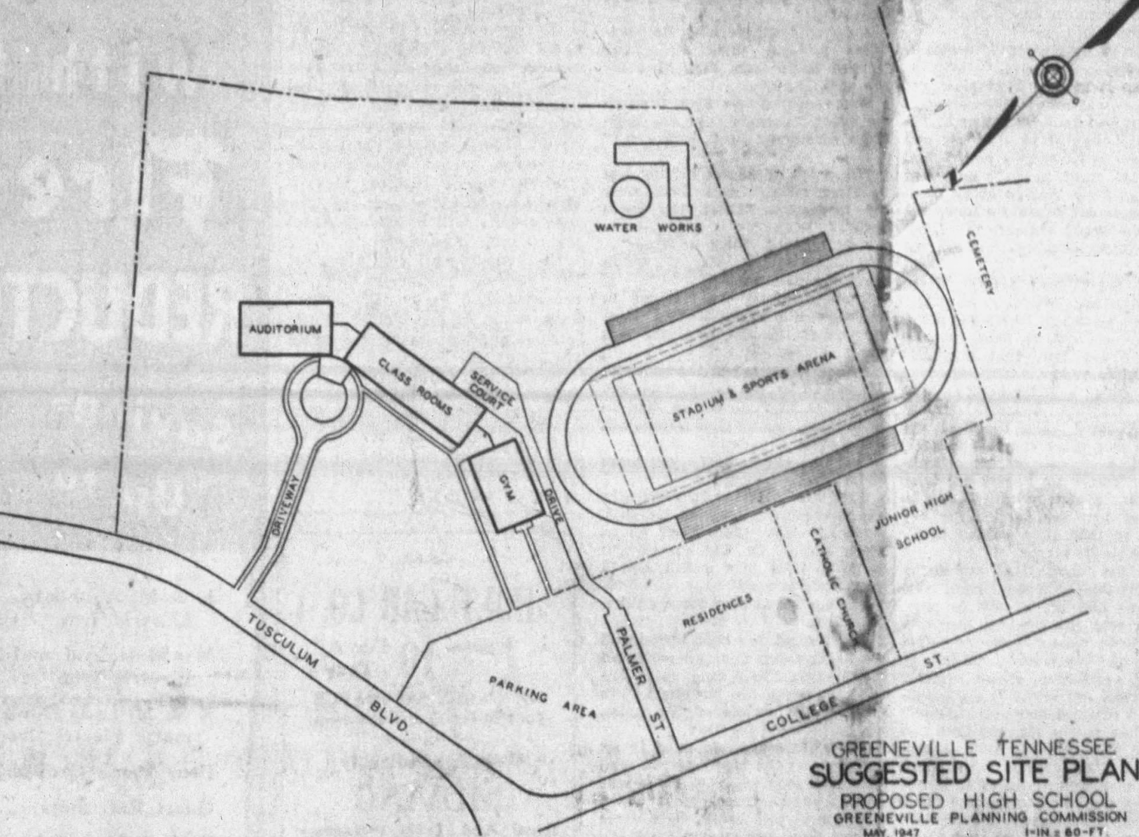
Plans for a new Greeneville High School and athletic complex began taking shape in 1947 on city-owned property along Tusculum Boulevard. The city’s existing community ball field was located near the road, while the Water Department occupied property higher on the hill behind the proposed school and stadium site. A site plan prepared by Ronald Scott of the Tennessee State Planning Commission called for the old ball field to be removed and the new high school and athletic facilities developed across the property.
The stadium was originally planned to have a track surrounding the playing field, but those plans were abandoned. The natural slope of the property helped determine the layout, but construction still required considerable grading. Community leaders organized the Greeneville Stadium Association on May 29, 1947, to raise the money necessary to have the football field ready for the upcoming season. J.C. McGuffin was elected president, Mayor James N. Hardin vice president, Rena Mae Morrow secretary and Austin Tallent treasurer. Civic organizations pledged their support, with season-ticket and gate sales expected to finance much of the work. The initial cost of preparing the field, providing bleachers and relocating lights from the old ball field was estimated at approximately $8,000.
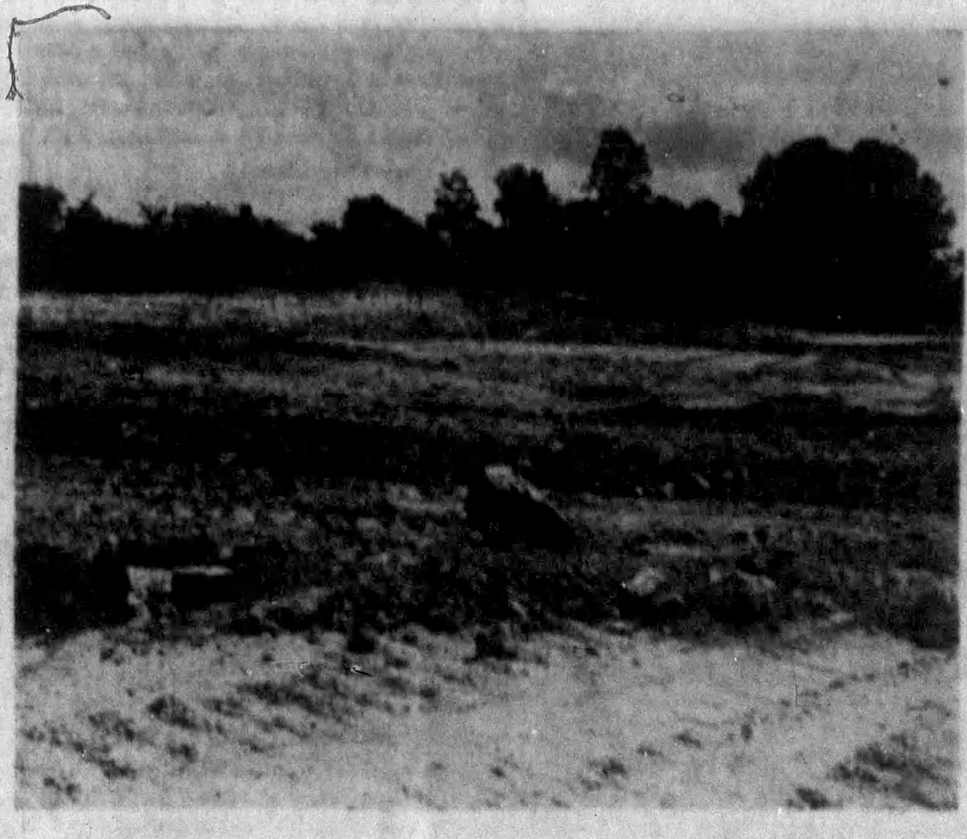
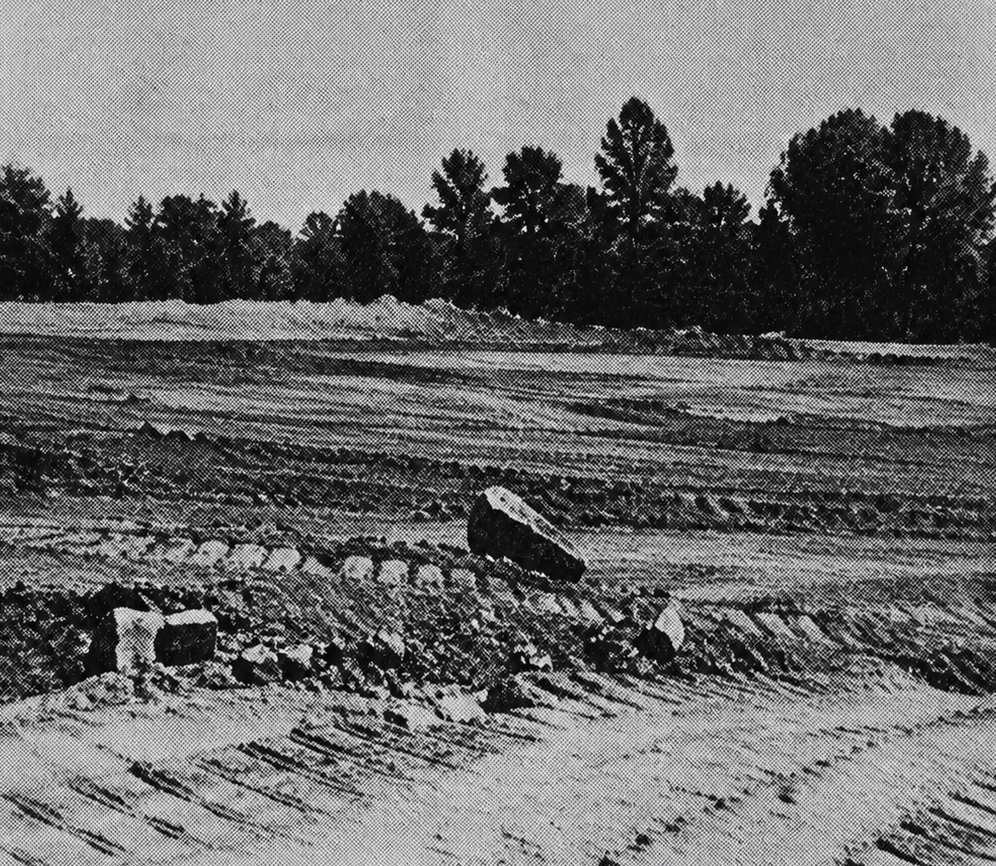
 Grading began on June 6, 1947. The work proved more difficult than simply leveling the property. Heavy summer rains slowed construction, and crews encountered substantial rock that required blasting. Several hundred feet of four-inch drainage tile were installed before topsoil was placed over the finished grade. Despite the difficulties, officials remained confident on Aug. 9, 1947, that the field would be ready for Greeneville’s first home game against Stair Tech on Sept. 26, 1947.
 By late August the field was ready for planting. Lime and fertilizer were spread over the field before it was seeded with a mixture that included Bermuda grass, rye and clover to establish a firm playing surface. Less than four months after grading began, Greeneville played the first game at its new stadium on Sept. 26, 1947.
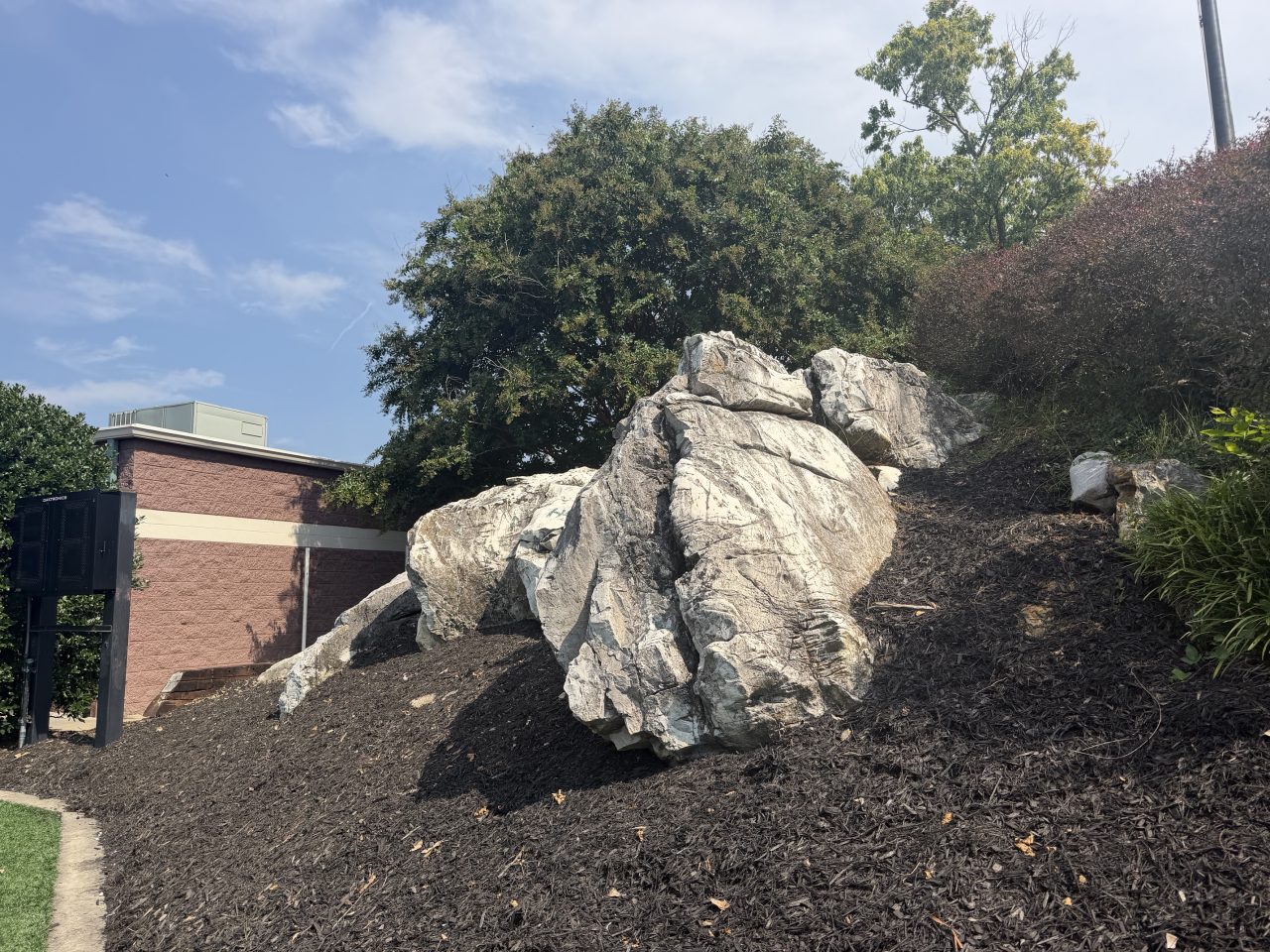
One feature of that original construction remains visible today. Although contemporary accounts specifically report that crews blasted rock while grading the field, a large natural limestone outcrop at the northeast corner was left in place. Why that particular formation survived is unknown. It would eventually become one of the stadium’s most recognizable landmarks. More on that below.
The Stadium Gets a Name
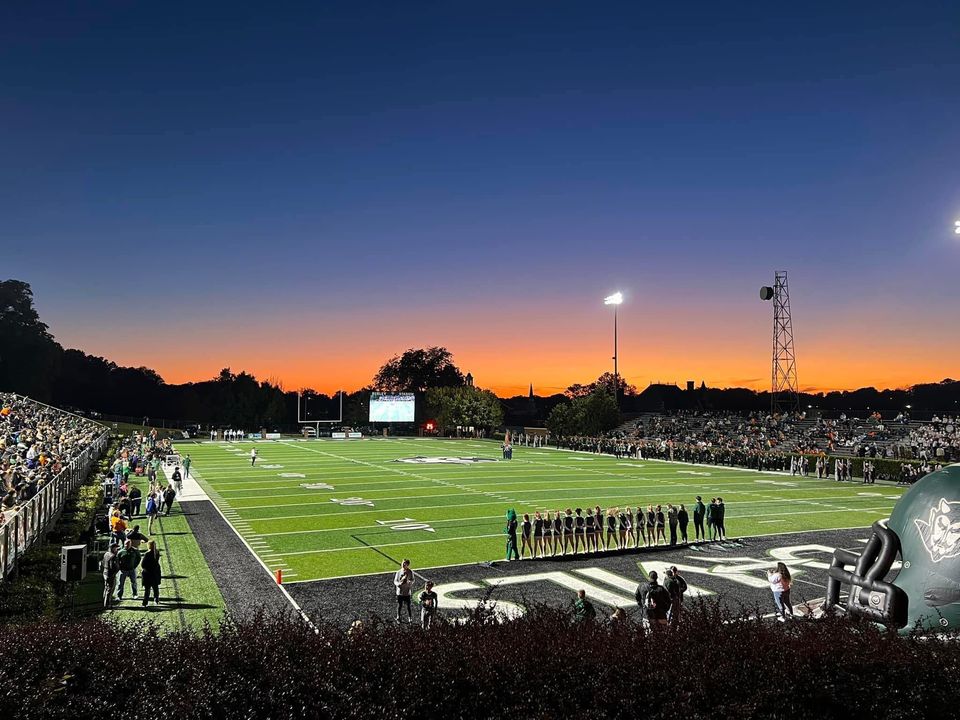
By the summer of 1948, Greeneville’s new football stadium had been in use for one season but still did not have an official name. On Aug. 10, 1948, the Greeneville Stadium Association invited residents of Greeneville and Greene County to submit suggestions. The association noted that the stadium, built during the summer of 1947 through a community effort led by Dr. J.C. McGuffin, now had seating for approximately 2,500 spectators and a playing field covered with luxuriant Bermuda grass. A permanent steel fence had also been erected, with Lombardy poplar trees planted along the fence.
On Aug. 16, 1948, the Stadium Association selected Burley Stadium as the name of Greeneville’s football field. The association said the name honored Greeneville’s tobacco market and Greene County’s tobacco crop. The name tied the stadium directly to one of the industries most closely associated with Greeneville and Greene County during that era.
Improvements continued during the summer of 1948. The Stadium Association launched a campaign to sell season tickets for both Tusculum College and Greeneville High School games. Tickets were priced at $1.20 at the gate and $5 for a season reserved seat, while Tusculum games were priced at $1.50. The stadium was also made available for George Clem High School football games on dates that did not conflict with Greeneville High School and Tusculum schedules.
New Fieldhouse
By Sept. 2, 1948, a new field house was nearing completion under the direction of Greeneville Police Chief Marion Laughters. Construction had begun only a few weeks earlier and was being rushed to completion before the opening of the 1948 football season. The building included dressing rooms and showers for home and visiting teams, storage for equipment and supplies, a ticket room, concession room and public restrooms.
The city was improving the surrounding grounds at the same time. A sidewalk was being installed around the field house, the area behind the stands was being paved with asphalt, and the road from College Street to the stadium was also being paved. A large parking area across from the ballpark was graded and surfaced with rock to accommodate several hundred automobiles. Alderman Eugene Fry said floodlights would be installed in the parking area, along with additional lighting on sidewalks and entrances.
By the beginning of the 1948 season, the facility that had opened only a year earlier was becoming much more than a newly graded football field. It now had a permanent name, improved seating and grounds, a field house, paved access, parking and other amenities.
The Rocks
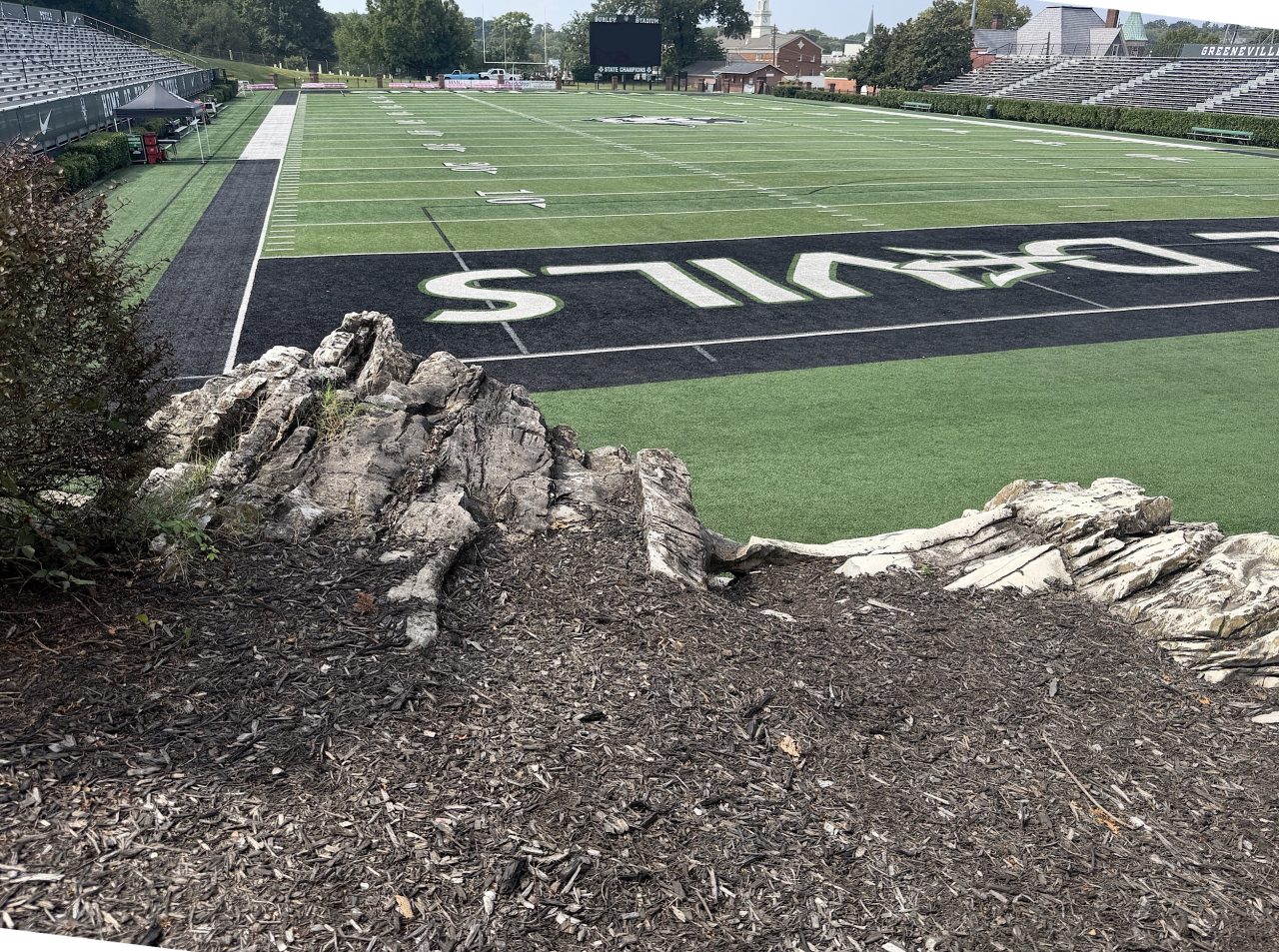
One of Burley Stadium’s most unusual features is the large gray and white limestone outcrop at the northeast corner of the field. Exposed limestone is common across East Tennessee, although not in a football end zone. The rocks themselves were never actually in the field of play, but the decision to leave them during construction in 1947 created a noticeable incline in that corner of the end zone.
At the intersection of the back line and sideline, the ground was roughly a foot higher than it was only a few feet toward the center of the end zone, creating a longtime inside joke that a Greeneville receiver had a built-in height advantage in that corner.
No one seems to know why this particular limestone formation wasn’t blasted away during construction in 1947 or why the field wasn’t shifted slightly to avoid it. Contemporary accounts establish that crews encountered substantial rock and did use blasting elsewhere while grading the stadium, so leaving this particular formation was apparently a choice rather than simply an inability to remove rock.
 Once the field and goalposts were established, the unusual corner became part of Burley Stadium. The stadium itself was built into the natural slope on the north side of Sevier Heights, allowing the original stands to take advantage of the terrain and reducing the excavation required.
Over the decades, the rocks went from simply being part of the landscape to becoming a Burley landmark. They were landscaped but remained prominent and became a familiar backdrop for photographs, including generations of homecoming queens following their coronations.
Synthetic Turf
2008
On Feb. 28, 2008, the Greeneville Board of Education approved the installation of synthetic turf at Burley Stadium. Private funding had been secured for the project, which was estimated to cost between $500,000 and $740,000. The donor or donors were not publicly identified.
The project presented an unusual challenge because of the rocks at the northeast end of the stadium. Rather than remove the longtime landmark, the entire playing field was shifted eight yards toward Old Harmony Graveyard and away from the rocks. Athletic Director Randy Richards summed up the decision at the time: “The rocks aren’t going anywhere.”
The move finally eliminated the incline that had existed in the corner of the end zone since 1947. The rocks, however, remained where they had been since the stadium was constructed.
 AstroTurf was installed across the entire playing surface, with work scheduled to begin April 1, 2008. In addition to football, the new surface provided a more reliable practice and competition area for other school athletic programs and the GHS Marching Band. School officials also cited improved drainage, reduced maintenance and increased safety among the benefits. At the time, painting the natural-grass field alone was costing an estimated $8,000 to $9,000 annually.
New Turf
2022
By 2022, Burley Stadium’s original synthetic turf had exceeded its expected lifespan and had become significantly hardened. School officials and Greeneville football coach Eddie Spradlen expressed concerns about player safety, and the Greeneville Board of Education moved forward with replacing the surface.
The original synthetic turf had been expected to last approximately 10 years, but regular maintenance extended its use to about 14 years. The replacement project cost just under $550,000 and was funded by the school board. Work was scheduled to begin immediately following graduation in May 2022.
Sources: The Greeneville Sun; WGRV and Radio Greeneville News; GHS annuals
About the Historical Images
Many of the historical photographs and illustrations on this page survive only through newspaper microfilm, photocopies or scans of the original publications. In some cases, those reproduction methods resulted in significant loss of contrast, clarity and fine detail.
Artificial intelligence was used to assist in cleaning up and enhancing selected historical images so they could be presented as clearly as possible. These images are not intended to be AI-generated interpretations of the original scenes. The enhancement process was reviewed with the goal of remaining as faithful as possible to the people, places, objects and events documented in the surviving images.
Because some details were already lost in the original microfilm or scanned reproductions, no enhanced version should be considered a replacement for the historical source. For transparency, the original image is included alongside or with each enhanced version for comparison.
The enhanced images are presented as an aid to viewing and understanding the historical record, while the original photographs and illustrations remain the authoritative source.