
T. W. Caskey Jr.
Greeneville High Head Football Coach, 1925
T. W. Caskey Jr. coached Greeneville High football for only one season, in 1925, but remained involved in education and athletics for most of his life. A World War I Navy veteran and college football player, he later spent more than three decades in the Steubenville, Ohio, schools while also pursuing a long interest in automobile racing.
Texas and World War I
Caskey was born Nov. 16, 1902, in Byers, Texas, a small community near the Oklahoma border about 20 miles northeast of Wichita Falls. His parents were T. W. and Ida Mae Hale Caskey.¹
Caskey was only 15 when he enlisted in the United States Navy during World War I, well below the Navy’s minimum enlistment age of 17. By May 30, 1918, when he was 15 years and six months old, he was serving aboard a convoy ship and was captain of a six-inch gun crew. During his service, his ship encountered an enemy craft at sea.²
After the war, Caskey returned to Texas and resumed his education.
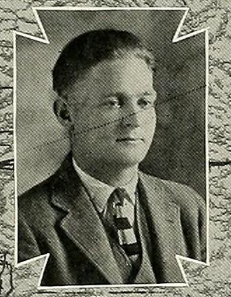
Midland College
In September 1920, Caskey left Wichita Falls for Midland, Texas, where he enrolled at Midland College.³
He quickly became involved in both athletics and campus life. Within weeks he was elected secretary of the student body, and that fall he played right halfback on the Midland football team.⁴
Caskey injured a knee in a motorcycle accident while riding on a cinder track at the college in 1921. By January 1922, he was a junior and had been selected as athletic editor of the college annual.⁵
In September 1923, Caskey left Texas for East Tennessee and Milligan College.⁶
Milligan College
Like many athletes of the period who were routinely identified in print by initials or nicknames, Caskey became known at Milligan as “Skey.”
He played varsity football during the 1923 season and played both tackle and fullback during his Milligan career. In 1924, coach James T. Edwards moved him from tackle to fullback, where he became one of the team’s leading backs. He earned a varsity football letter that season.⁷
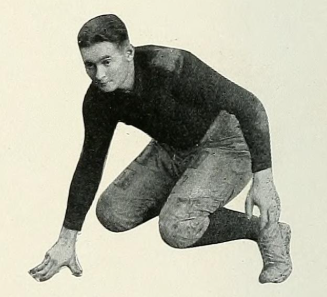
Caskey was also active throughout the college. He became president of the American Literary Society, belonged to the Dramatic Club and served as associate editor of The Trident, Milligan’s monthly student publication. He was also a member of the M Club, an organization limited to varsity lettermen in football, basketball and baseball.⁸
He was active in intercollegiate debate as well. During his senior year, Caskey represented Milligan in competition involving Carson-Newman and Lincoln Memorial and was selected for Milligan’s affirmative team in a debate with Lincoln Memorial.⁹
Caskey graduated from Milligan in May 1925 with a Bachelor of Science degree. He was one of 14 members of the graduating class.¹⁰
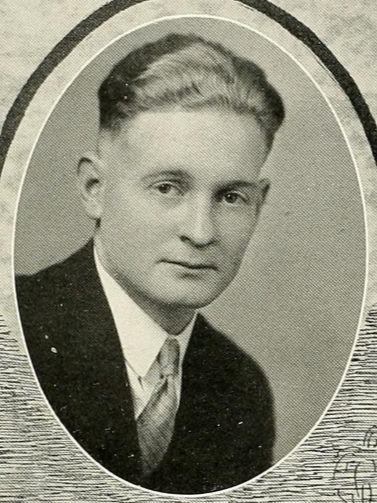
While still a student, Caskey married Dorothy Brown of Newbern, Tennessee, on Jan. 2, 1925. The marriage was kept private while they continued their college work and was announced publicly the following year. Dorothy remained at Milligan after Caskey’s graduation to complete her own degree.¹¹
Greeneville High
Caskey returned to Texas after graduating from Milligan, but only for the summer. By June 1925, he had accepted a teaching position in Greeneville and planned to return to Tennessee for the coming school year.¹²
That fall, he became head football coach at Greeneville High School. Coaching changes had been frequent during the early years of the program, and Caskey became the fourth different coach in four seasons.
Greeneville had not yet adopted the Greene Devils name. The school’s teams were associated with its purple and gold colors and were known by several variations during the period. In September 1925, the Greeneville Democrat-Sun referred to Caskey’s team specifically as the Purple Devils.¹³
Caskey had the team practicing twice daily by early September. The Purple Devils finished 1-7-2 in his only season as head football coach.¹⁴
Caskey also coached the Greeneville boys basketball team. In February 1926, Greeneville entered the fourth annual Upper East Tennessee High School basketball tournament at State Teachers College in Johnson City. The tournament attracted 47 teams. Greeneville defeated Jonesboro 38-25 in the opening round before losing 24-2 to Johnson City.¹⁵
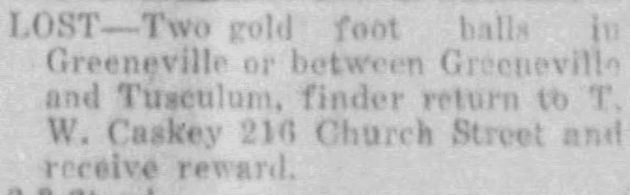
A small advertisement in March 1926 placed Caskey at 216 Church Street in Greeneville. He offered a reward for the return of two lost gold footballs.¹⁶
Wisconsin and Ohio
After leaving Greeneville, Caskey continued his education at the University of Wisconsin, where he earned a master’s degree. By July 1928, he was living in Madison.¹⁷
By September 1928, Caskey and Dorothy were living in Steubenville, Ohio. Steubenville would remain his home for more than 35 years.¹⁸
Caskey worked for the Steubenville Board of Education at Steubenville High School, building a career that combined teaching and athletic administration. His 1942 registration card lists the Board of Education as his employer and Steubenville High School as his place of employment.
By the early 1940s, he was serving as faculty manager of athletics at Steubenville High School, and he was later commonly identified as the school’s athletic director. In 1943, he directed the district Class A basketball tournament held at Steubenville.¹⁹
Caskey also served on the Eastern Ohio Athletic Board, giving him a role in administering interscholastic athletics beyond Steubenville.²⁰
Automobile Racing
Caskey also spent more than 20 years involved in automobile racing as a car owner and mechanic.
His racing partnership with former Steubenville High student Jack “Johnny” Lorenzo began in 1930, when Lorenzo was 15. Caskey had been Lorenzo’s athletic instructor, and the two remained associated in racing for many years.²¹
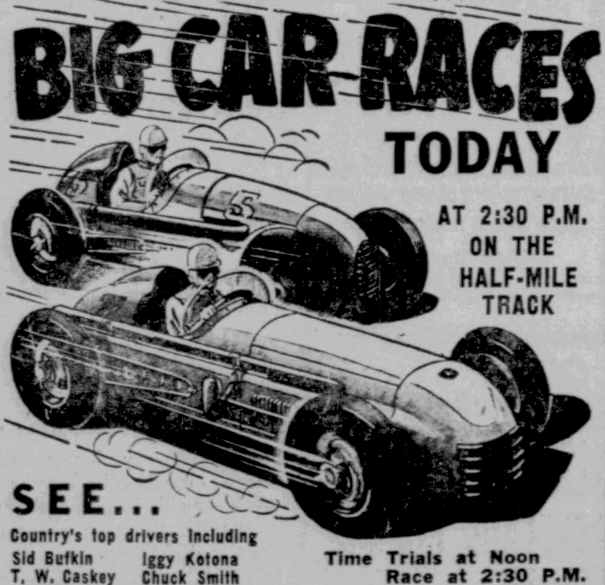
By 1938, Caskey was competing on the racing circuit as a mechanic and car owner. That July he suffered brush burns when a racing car went out of control at Jamestown Motor Speedway.²²
In 1941, Caskey owned the Caskey-Hal Special, driven by Carl Scarborough of Michigan.²³ Scarborough later competed in the Indianapolis 500 and died from heat prostration following the 1953 race.²⁴
By 1946, Lorenzo was driving Caskey’s No. 5 Caskey Dreyer. Two years later, Caskey owned several racing cars.²⁵
His involvement in automobile racing extended for more than two decades.
World War II
Caskey returned to wartime service during World War II.
In April 1943, he entered the United States Maritime Service for Merchant Marine training.²⁶ He served as an officer in the Merchant Marine during the war.²⁷
It was his second period of service at sea, following his Navy service as a 15-year-old during World War I.
The Spring Football Debate
In 1949, Caskey led an unsuccessful effort to eliminate spring football practice in Ohio high schools. He argued that spring football drew athletes away from track, baseball, golf and tennis, placed schools without spring practice at a disadvantage and unnecessarily extended the football season.²⁸
Caskey proposed that football practice begin around Aug. 20 instead. He contacted 110 Ohio schools in an effort to build support for a statewide vote, but only 43 responded favorably and the proposed poll was dropped.²⁹
The position provides an interesting contrast with his own early coaching career. At Greeneville in 1925, Caskey had put his football team through twice-daily preseason practices; nearly a quarter-century later, as an athletic administrator, he was arguing against allowing football to consume athletes and resources during another sports season.
South Carolina
Caskey remained in Steubenville until moving to Cayce, South Carolina, in 1964.³⁰
He continued teaching after the move. For the 1965-66 school year, Caskey joined the faculty of Fulmer Junior High School, where he taught social studies.³¹
T. W. Caskey Jr. died Jan. 11, 1970, in Columbia, South Carolina. He was 67.³²
Footnotes
- World War II registration card for T. W. Caskey Jr., giving his birth as Nov. 16, 1902, at Byers, Texas; “T. W. Caskey,” The Greenville News (Greenville, South Carolina), Jan. 12, 1970, p. 5.
- Wartime correspondence concerning Caskey’s Navy service, May 30, 1918; additional wartime correspondence, September 1918. Based on his Nov. 16, 1902, birth date, Caskey was 15 years, six months old on May 30, 1918.
- Wichita Falls newspaper, Sept. 10, 1920; additional Wichita Falls account, Sept. 12, 1920, concerning Caskey’s departure for Midland College.
- Midland-area newspaper accounts, Oct. 22, 1920, concerning his election as student body secretary, and Nov. 19, 1920, listing Caskey at right halfback.
- Midland newspaper accounts, 1921, concerning Caskey’s motorcycle accident, and January 1922, identifying him as a junior and athletic editor of the college annual.
- Wichita Falls newspaper, Sept. 2, 1923, concerning Caskey’s departure for Milligan College.
- Milligan College, The Buffalo, 1924; Wichita Falls newspaper, December 1924, concerning Caskey’s football career at Milligan; Milligan football banquet account, Dec. 15, 1924.
- Milligan College, The Buffalo, 1924 and 1925, including American Literary Society, Dramatic Club, Trident and M Club listings.
- Milligan-area newspaper accounts, February and March 1925, concerning intercollegiate debate and Caskey’s election as president of the American Literary Society.
- Milligan commencement coverage, May 1925, listing T. W. Caskey Jr. among the Bachelor of Science graduates.
- Newspaper announcement of the Caskey-Brown marriage, January 1926; Milligan College, The Buffalo, 1926.
- Wichita Falls newspaper, June 3, 1925, reporting Caskey’s plans to teach in Greeneville, Tennessee.
- “Future Look Great for the Purple Devils,” Greeneville Democrat-Sun (Greeneville, Tennessee), Sept. 7, 1925, p. 4.
- Greeneville Democrat-Sun, Sept. 7, 1925, p. 4; Greeneville High School historical football records, 1925 season. The latter records Caskey’s team at 1-7-2. Pasted markdown(20260929-222009)
- Johnson City Chronicle (Johnson City, Tennessee), Feb. 24-25, 1926, coverage of the Upper East Tennessee High School basketball tournament.
- Greeneville Democrat-Sun, March 4, 1926, p. 5.
- Wichita Falls newspaper, July 1928, placing Caskey in Madison, Wisconsin; “T. W. Caskey,” The Greenville News, Jan. 12, 1970, p. 5.
- Georgetown News, Sept. 5, 1928, p. 5, identifying Mr. and Mrs. T. W. Caskey Jr. of Steubenville, Ohio.
- World War II registration card for T. W. Caskey Jr.; Evening Review, March 8, 1943, concerning the district Class A basketball tournament at Steubenville.
- The Evening Review (East Liverpool, Ohio), March 3, 1951, p. 8.
- Pittsburgh Press (Pittsburgh, Pennsylvania), May 29, 1948. The article described Caskey and Lorenzo as racing partners for 18 years, placing the beginning of their association in 1930.
- Warren Times Mirror (Warren, Pennsylvania), July 11, 1938.
- The Dayton Herald (Dayton, Ohio), May 6, 1941, p. 17. The article identifies Scarborough as driver of the Caskey-Hal Special and Caskey as its owner. The_Dayton_Herald_1941_05_06_17
- The State (Columbia, South Carolina), May 31, 1955, p. 19. The_State_1955_05_31_19
- The Newark Advocate (Newark, Ohio), June 7, 1946, p. 12; July 13, 1946, p. 6; Pittsburgh Press, May 29, 1948. The July 1946 article specifically identifies Jack Lorenzo as the driver of the Caskey Dreyer. The_Newark_Advocate_1946_07_13_6
- Pittsburgh Post-Gazette (Pittsburgh, Pennsylvania), April 24, 1943, concerning United States Maritime Service enrollees from the Pittsburgh district.
- “T. W. Caskey,” The Greenville News, Jan. 12, 1970, p. 5.
- The Independent (Massillon, Ohio), April 27, 1949, p. 18; The Zanesville Signal (Zanesville, Ohio), April 25, 1949, p. 10; Chillicothe Gazette (Chillicothe, Ohio), April 25, 1949, p. 10.
- The Cincinnati Enquirer (Cincinnati, Ohio), May 4, 1949, p. 26; News Journal (Mansfield, Ohio), May 5, 1949, p. 22.
- “T. W. Caskey,” The Greenville News, Jan. 12, 1970, p. 5.
- The Columbia Record (Columbia, South Carolina), April 15, 1965, p. 17.
- “T. W. Caskey,” The Greenville News, Jan. 12, 1970, p. 5.