
Leonard A. Coffman
Greeneville High Head Football Coach, 1955–1959
Leonard Amos Coffman was born April 23, 1915, and spent much of his childhood in Bell County, Kentucky. By his high school years, athletics had become an important part of his life, eventually leading him from Middlesboro to Greeneville, the University of Tennessee and a career that included college and high school coaching, military service, education and football officiating.
Coffman joined the Middlesboro High football program in 1933 and became a regular in the backfield that fall. At 5-foot-8 and 155 pounds, he was the largest member of the Middlesboro backfield. He was already developing the characteristics that would define him throughout his football career: he worked hard, diagnosed plays well, tackled aggressively and was particularly effective as a blocker.¹
Coffman also proved his toughness when he suffered a broken nose during the 1933 season. He returned to action wearing a specially designed helmet to protect his face. Football was not his only sport. Coffman became a starting guard for the Middlesboro basketball team, earning praise for both his defense and scoring.²
All-Kentucky at Middlesboro
During the 1934 football season, Middlesboro used Coffman primarily at fullback, although he was once jokingly described as “the fullback who believes himself a halfback.” More important was his reputation as the team’s outstanding blocker. He was also a strong runner, reliable receiver and hard tackler.³
Coffman briefly left the team in November 1934 after a disagreement with Coach Thomasson. The separation lasted only a day. The dispute was settled, Coffman returned to practice, and the Daily News announced his return under the headline “Coffman Is Back!”⁴
A more significant issue was Kentucky’s eight-semester eligibility rule. Coffman still had another year of high school to complete academically, but the rule ended his eligibility for further Kentucky high school football competition following the 1934 season. His ability seemed particularly well suited to the style of football being played at the University of Tennessee. Coffman could block and tackle, lead interference for another runner and back up the line, qualities that prompted a remarkably accurate prediction that he could become “the very man to play full back at Tennessee under the Neyland plan.”⁵
Coffman completed the season with substantial recognition. He was chosen first-team fullback on the Cumberland Valley Conference team, the only Middlesboro player selected for the first team, and was regarded as an excellent blocker and tackler as well as a powerful runner. The Louisville Courier-Journal selected him second-team All-State, while Coffman also received consideration for the first team.⁶
Although his Kentucky football eligibility had expired, Coffman remained at Middlesboro through the spring of 1935. He continued playing basketball, participated in local boxing matches and completed the school year before his football career took him across the state line to Tennessee.
Greeneville High School
Before the 1935 football season, Coffman entered Greeneville High School and joined a team coached by Ty Disney. Disney also had Middlesboro connections, having played there before attending the University of Tennessee and later returning as an assistant coach. Coffman arrived in Greeneville as an experienced back who had already established an All-Kentucky reputation.
Coffman played his final high school football season for Disney in 1935. A multi-sport athlete, he also continued playing basketball before graduating from Greeneville High in 1936. In September, Coffman was among the Greeneville students entering the University of Tennessee. The prediction made in Middlesboro less than two years earlier was about to become reality: Coffman was going to play football in Robert Neyland’s system.⁷
Tennessee and Robert Neyland
Coffman played varsity football at Tennessee from 1937 through 1939, primarily at fullback. His game was particularly well suited to Neyland’s single-wing system. Coffman could run the football, but blocking, tackling, short-yardage power and defensive play were central to his value. The same characteristics that had distinguished him in high school became important parts of his role on some of the greatest teams in Tennessee history.
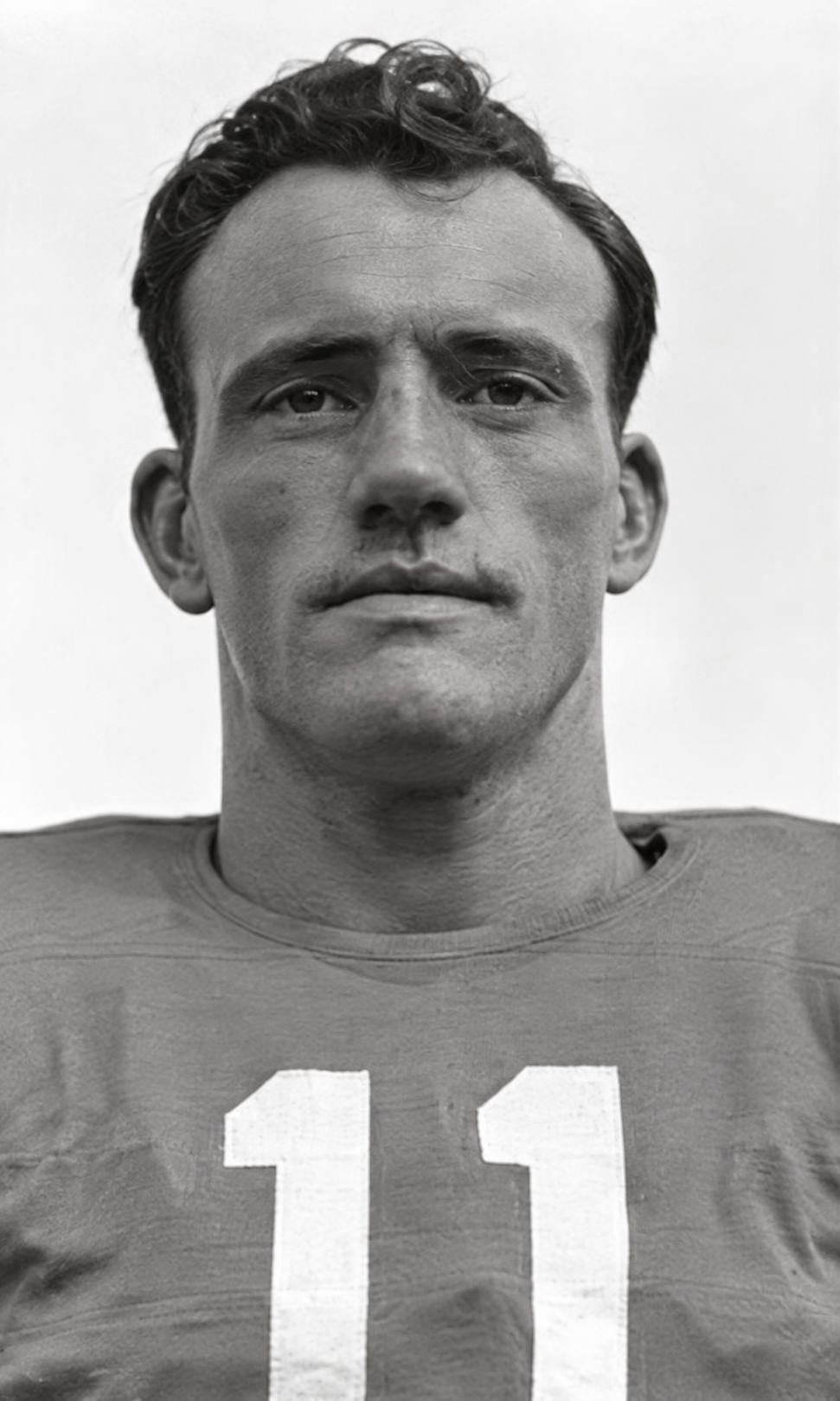
His success at Tennessee also revived some hometown rivalry over where his football development had begun. When Knoxville sportswriters referred to Coffman as a Greeneville product, Middlesboro objected. Coffman had played only his final high school season at Greeneville after already earning All-Kentucky recognition at Middlesboro, and his former hometown was not willing to let Greeneville take full credit for producing him.⁸
The 1938 Volunteers went undefeated, won the Southeastern Conference championship and defeated Oklahoma 17-0 in the Orange Bowl. Coffman was part of a backfield that included George Cafego, Bob Foxx and Sam Bartholomew. Tennessee finished 11-0, and Coffman’s performance earned him second-team All-SEC recognition from the Associated Press.⁹
The following season produced an even more unusual accomplishment. Tennessee completed the 1939 regular season 10-0 without allowing a single opponent to score. The Volunteers outscored those ten opponents 212-0 before losing to Southern California in the Rose Bowl. Coffman was a starter on both the 1938 and 1939 teams.
Coffman’s physical style became part of his reputation among his teammates. George Cafego remembered that the sight of Coffman’s neck turning red was a warning that someone had made him angry. John Bailey, another Tennessee player who later coached at the university, described Coffman as the toughest and meanest football player Tennessee had produced. The descriptions were consistent with the player whose blocking and tackling had first distinguished him at Middlesboro.¹⁰
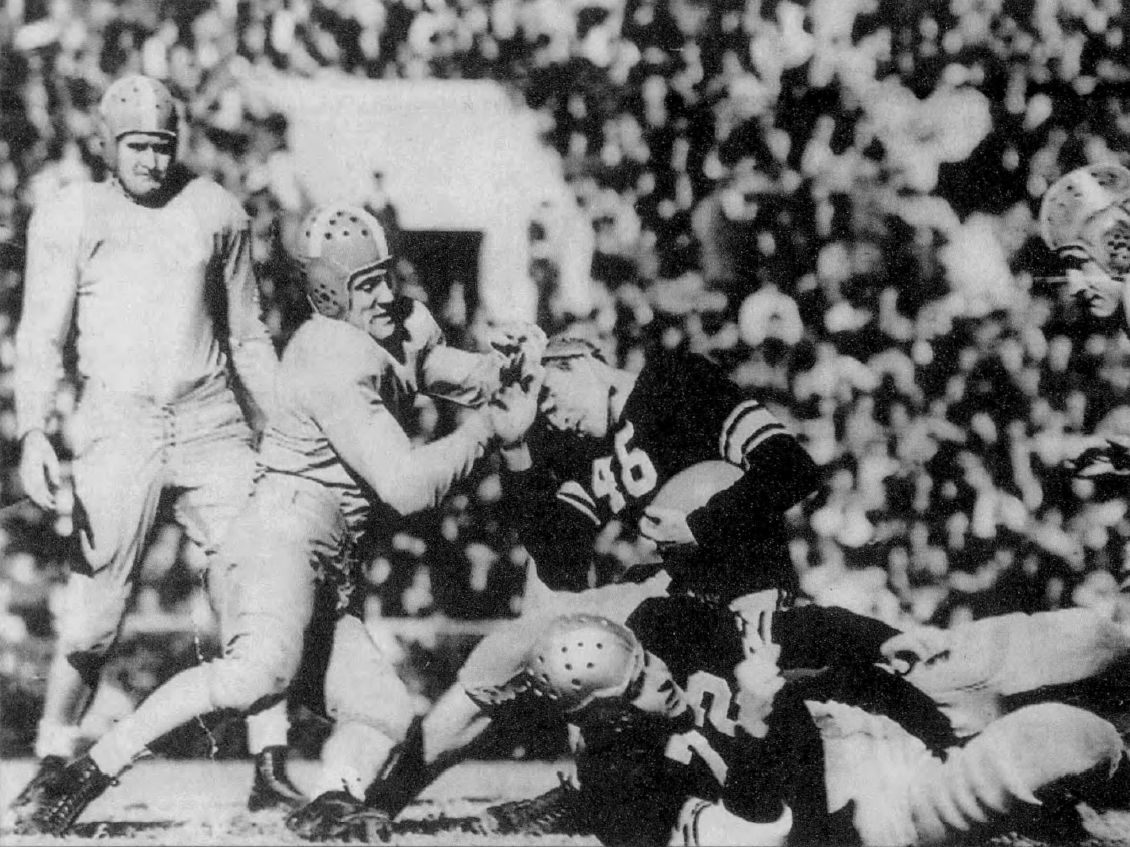
Neyland’s discipline produced another story that followed Coffman for the rest of his life. Coffman once left Knoxville without permission and made a trip to Greeneville. When Neyland confronted him, he asked how far it was from Knoxville to Greeneville. Coffman answered 72 miles. Neyland assigned him 72 laps around the track, with team manager Dink Eldridge counting them.¹¹
Greeneville was also where Coffman’s future wife, Jennie King, lived. Coffman and Jennie would marry in 1941.
The Dive
Coffman and Neyland are also credited with developing a technique that eventually became routine at every level of football: deliberately sending the ball carrier airborne over a packed defensive line in short-yardage situations.
Before Tennessee’s Oct. 15, 1938, game against Alabama at Legion Field in Birmingham, Neyland anticipated a particular problem near the goal line. Alabama’s defensive linemen attacked low, creating a pile that made conventional short-yardage running difficult. Neyland worked with Coffman on a different approach. Instead of trying to drive through the mass of linemen, Coffman would launch himself over it.
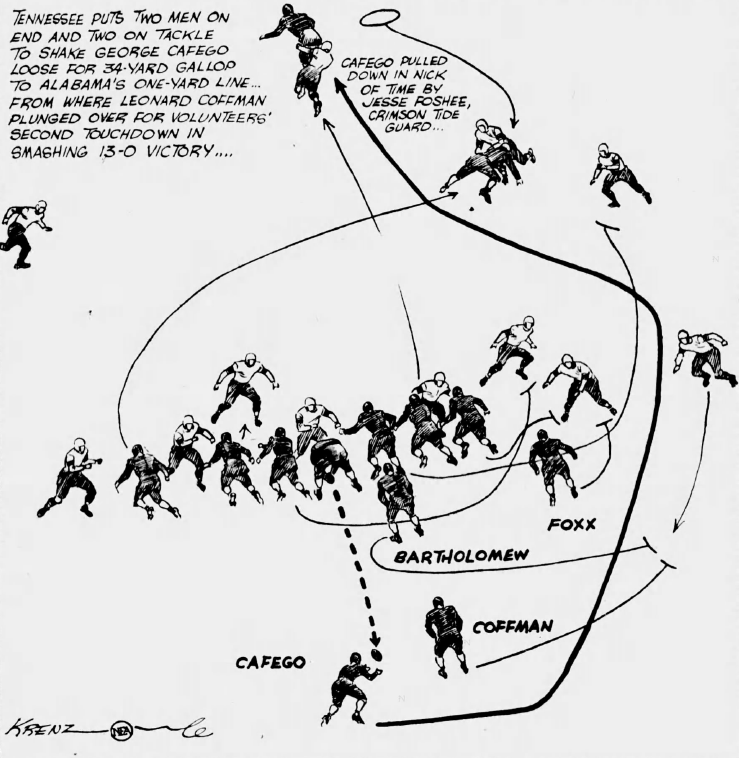
Tennessee had practiced the maneuver before the Alabama game but had not needed to use it. Alabama provided the occasion. Tennessee drove to the goal line, and Coffman went over the top for a touchdown. Later in the game, he did it again. Coffman scored both Tennessee touchdowns in a 13-0 victory, one in the first quarter and another in the third.¹²
The technique was essentially the modern goal-line dive. Rather than following blockers through an opening, the runner treated the pile itself as the obstacle to be cleared, leaving the ground and carrying the football over the defensive front.
Coffman was later credited as the first back in major college football to use the dive deliberately as a short-yardage tactic. Its significance was not simply that a football player had left his feet while carrying the ball. Neyland and Coffman had practiced the maneuver as a designed solution to a defensive technique and then successfully used it to score.¹³
The Alabama game also was an important step in Tennessee’s undefeated season. Alabama entered the contest unbeaten, and Coffman’s two one-yard touchdowns accounted for all of Tennessee’s touchdowns in the 13-0 victory. The Volunteers completed the season 11-0 with a 17-0 victory over Oklahoma in the Orange Bowl.¹⁴
From Player to Coach
After completing his playing career, Coffman remained at Tennessee and worked as an assistant under Neyland during the 1940 and 1941 seasons. The move began a coaching career almost immediately after his college playing days ended and allowed him to continue learning under the coach whose system had shaped him as a player.¹⁵
Coffman and Jennie King married June 15, 1941. With the United States entering World War II later that year, Coffman’s career soon shifted from football to military service.
He entered active Army service in March 1942 as a lieutenant and was assigned to the 16th Training Battalion at Camp Wheeler near Macon, Georgia, where he served as an instructor. Football soon became part of his military service as well. Neyland had returned to active duty, and Coffman was selected for an All-Army Eastern team assembled from outstanding former college players serving in the Army.¹⁶
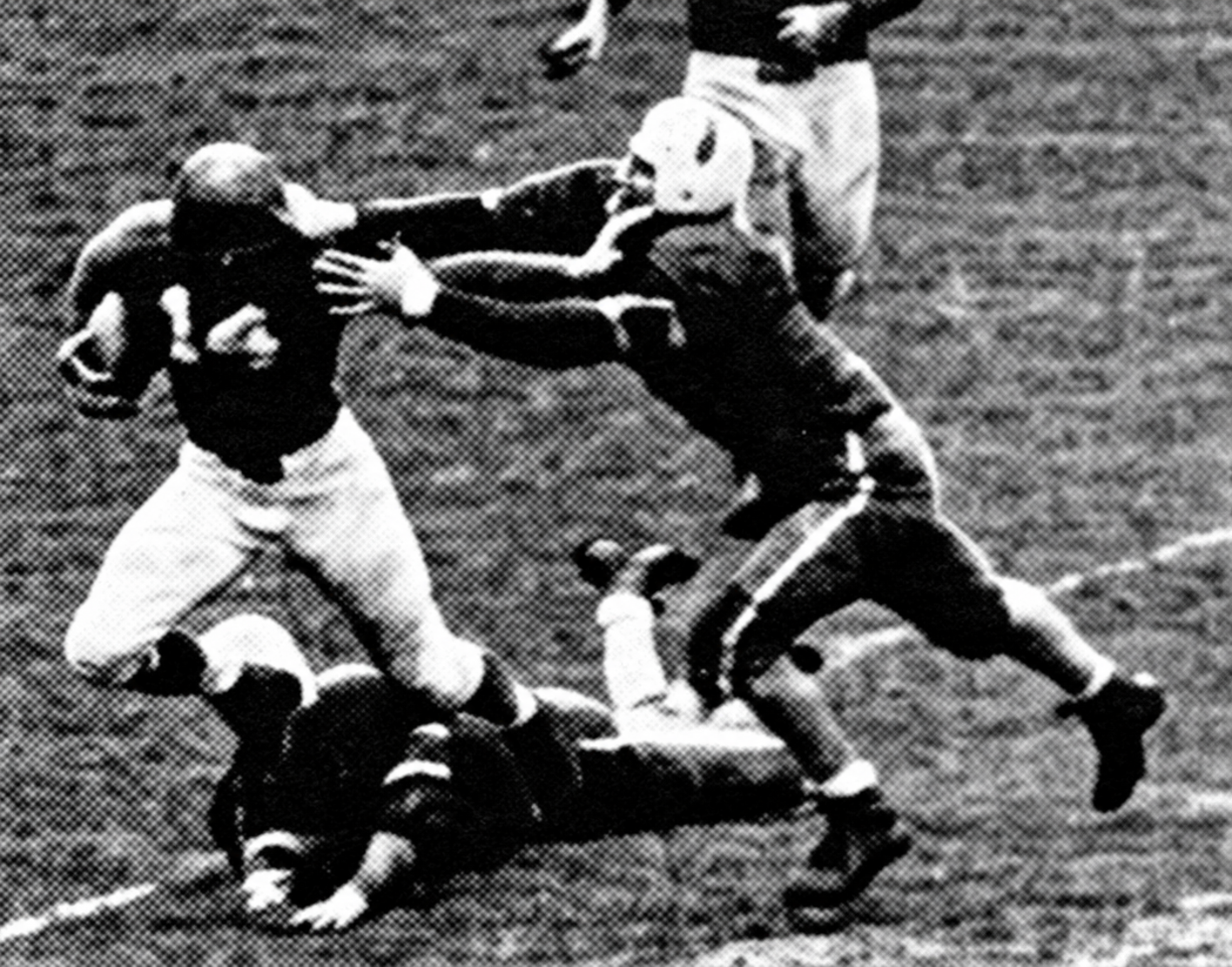
During an August 1942 scrimmage at New Haven, Connecticut, Coffman was struck around the eye and hospitalized. He was treated for a concussion but soon rejoined the team. On Sept. 16, Coffman played against the professional Brooklyn Dodgers in Baltimore and scored from the two-yard line for the Army team’s second and decisive touchdown in a 13-7 victory.¹⁷
World War II
Coffman’s regular military career continued after the Army football exhibitions. He was promoted to captain in March 1943, received advanced training at Fort Benning, Georgia, and later served at Camp Hood, Texas. His wartime service eventually took him to the Pacific theater, where football again became part of his duties and he coached an Army team. He rose to the rank of major before completing his wartime service.¹⁸
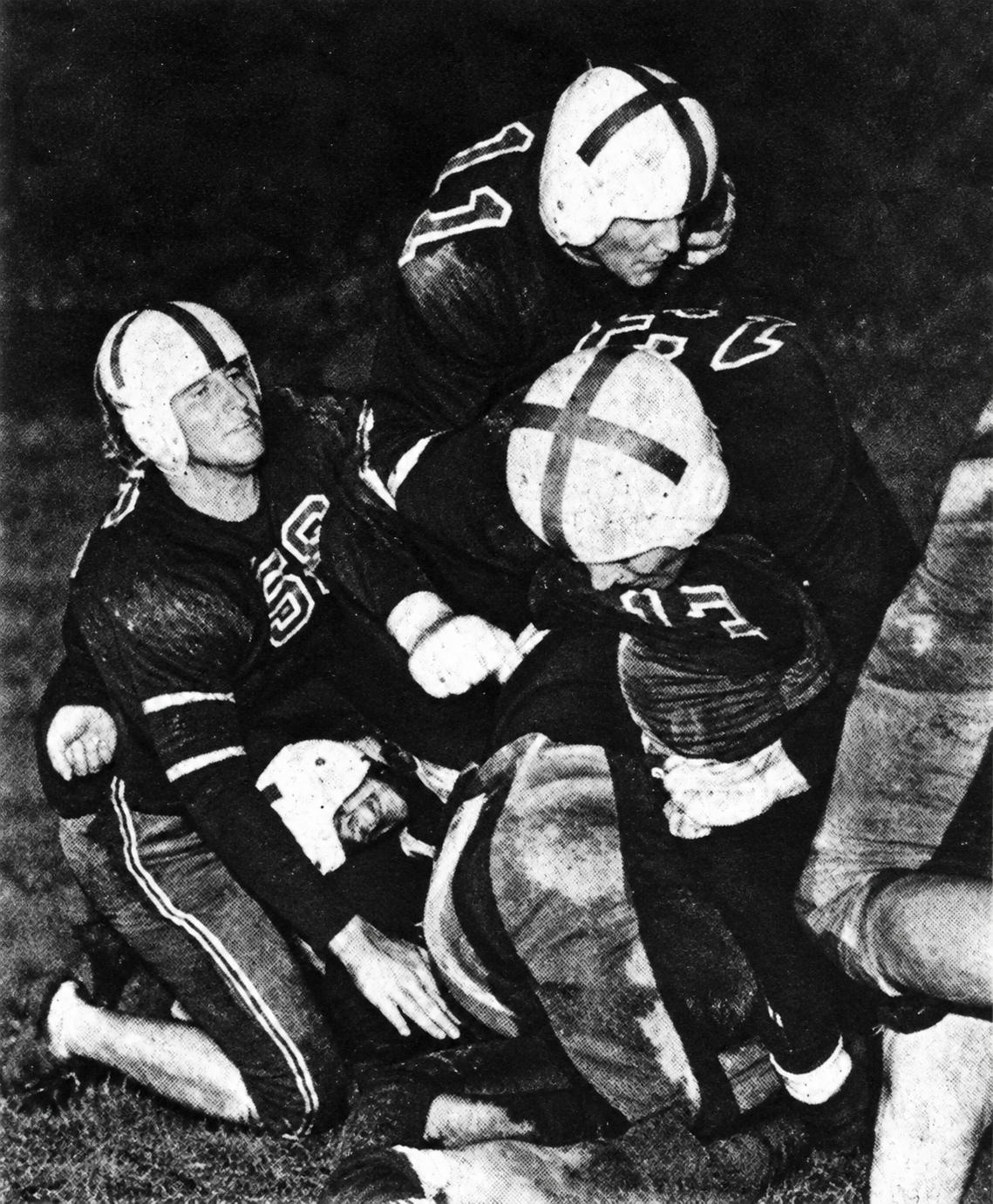
Coffman returned from the Pacific in 1946 and came back to East Tennessee while on terminal leave. He briefly worked for a telephone company in Knoxville, but his absence from football did not last long. That summer he accepted a position on the coaching staff at the University of Wyoming.¹⁹
University of Wyoming
The University of Wyoming hired Coffman as backfield coach in July 1946. When former Tennessee player Bowden Wyatt became Wyoming’s head coach in 1947, Coffman was retained, beginning a long association between the two former Volunteers. Wyatt would later become head coach at Tennessee.²⁰
Coffman’s responsibilities extended beyond coaching the backfield. He became one of Wyatt’s principal scouts and developed enough of a reputation that his name surfaced as a possible successor when Wyatt was being mentioned for other jobs in 1949. George Cafego eventually joined the Wyoming staff as well, giving the program several coaches with direct ties to Neyland and Tennessee.
Military service intervened again in 1951 when Coffman was recalled to active duty as a major. He was assigned as an ROTC infantry instructor at the University of Wyoming, which allowed him to remain in Laramie. Although his Army assignment initially appeared likely to end his football duties, Coffman continued to be associated with the Wyoming coaching staff during 1951 and 1952.²¹
When Wyatt left Wyoming for Arkansas after the 1952 season, Coffman again received consideration as a possible successor. Phil Dickens was hired instead, and Coffman became the only member of Wyatt’s staff retained by the new coach. He remained through spring practice before deciding to return to Tennessee.
Coffman resigned from Wyoming in May 1953, ending a seven-year association with the university. He had joined the staff under Bunny Oakes, remained under Wyatt and was retained briefly by Dickens.²²
Return to East Tennessee
Coffman returned to East Tennessee intending to enter private business, which he initially did. In July 1953, he purchased a filling station in Johnson City. The venture was brief, and in October the Coffmans returned to Greeneville, where Leonard went to work for Magnavox.²³
Education and athletics soon became Coffman’s principal occupation again. He became principal and football coach at Hot Springs High School in North Carolina and served there for two years while living in Greeneville and commuting to Hot Springs.
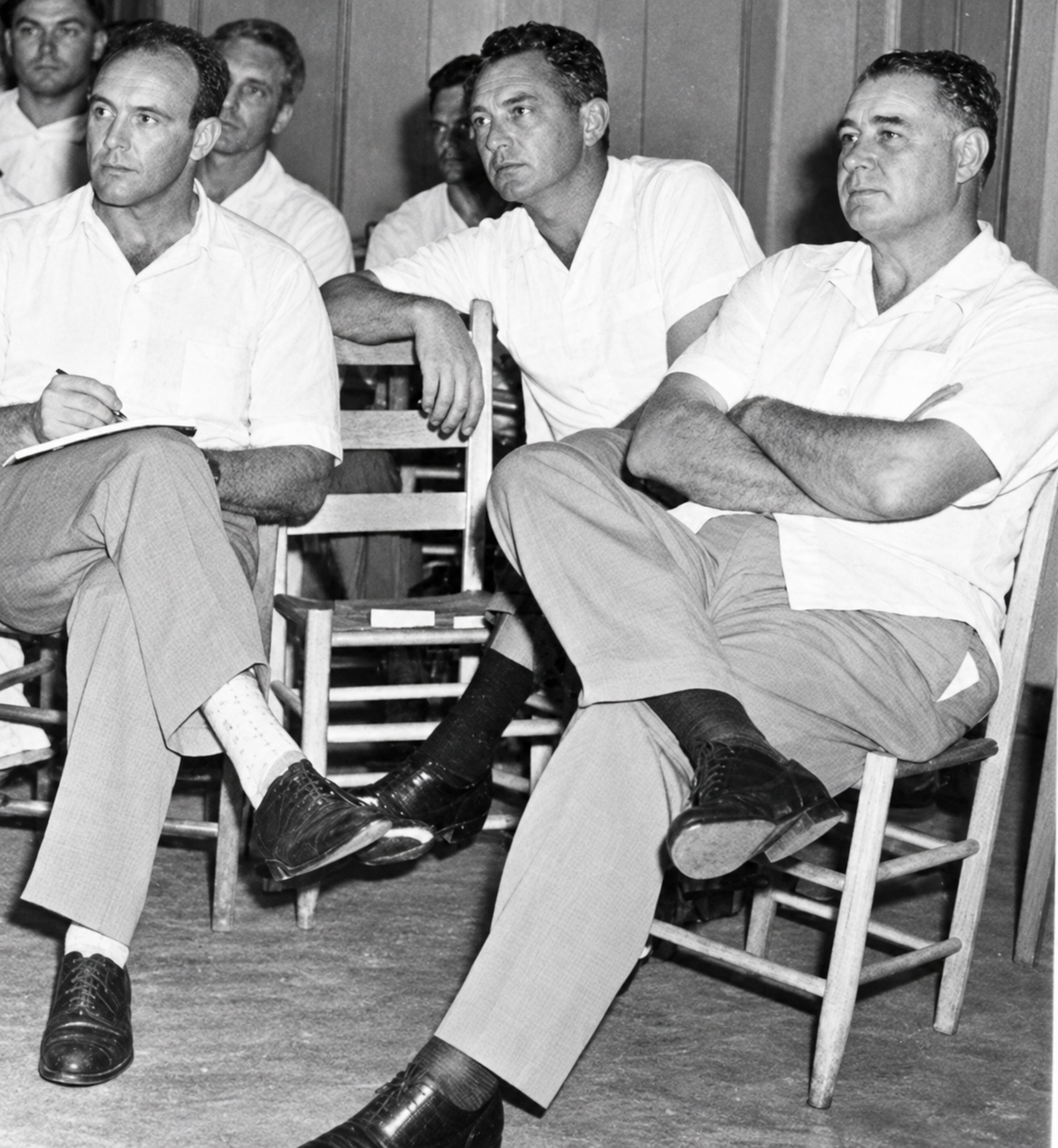
Greeneville High was also approaching another coaching transition. Ty Disney left the head football position in the spring of 1955, and Coffman emerged as one of the candidates to succeed him. Coffman’s succession fit a pattern already seen at Greeneville, where former players shaped by the same college programs and coaching systems frequently moved into coaching positions themselves. Coffman had played for Disney at Greeneville in 1935; twenty years later, he was selected to succeed him.
On April 26, 1955, the Greeneville Board of Education named Coffman head football coach. He brought a bachelor’s degree from Tennessee, graduate work at Wyoming and experience ranging from Neyland’s Tennessee staff to seven seasons of college coaching. Coffman later received his master’s degree from the University of Wyoming in 1958.²⁴
Greeneville High Head Coach
Coffman made clear upon his hiring that Greeneville would continue to use the Tennessee single-wing system. He was willing to add formations when personnel justified them, but the foundation would be the football he had learned under Neyland.
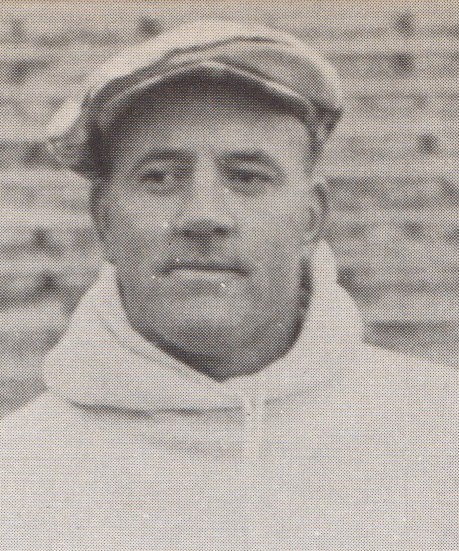
That philosophy completed a progression that had begun more than 20 years earlier. In 1934, before Coffman ever played at Tennessee, his blocking, tackling and ability to lead interference had been identified as qualities particularly suited to the “Neyland System.” He eventually played in that system, coached under Neyland, carried its principles into college coaching and then brought them back to Greeneville as a head coach.
Coffman coached Greeneville for five seasons, from 1955 through 1959. His tenure also continued the connection with Disney that had begun during Coffman’s own high school career. Disney coached Coffman at Greeneville in 1935, and Coffman succeeded him in 1955, making both men part of Greeneville’s long connection to the Tennessee single-wing tradition.
After leaving the head coaching position, Coffman remained in education. His career increasingly moved toward teaching and administration in the Greeneville and Greene County school systems, while football remained an important part of his life through officiating.
Education, the Army Reserve and Public Service
Coffman continued his military career in the Army Reserve and eventually attained the rank of lieutenant colonel. A veteran of World War II and the Korean War era, he remained active in the Reserve for years after his return to civilian life. In 1964, he completed instructor training at the Command and General Staff College at Fort Leavenworth, Kansas, while assigned to the 3281st Army Reserve Logistics Command.²⁵
His work in education also extended beyond his regular school duties. In November 1963, Coffman served on an evaluation team at North Greene High School representing the Southern Association of Schools as North Greene sought accreditation. A decade later, he was serving as secretary of the East Tennessee Education Association.
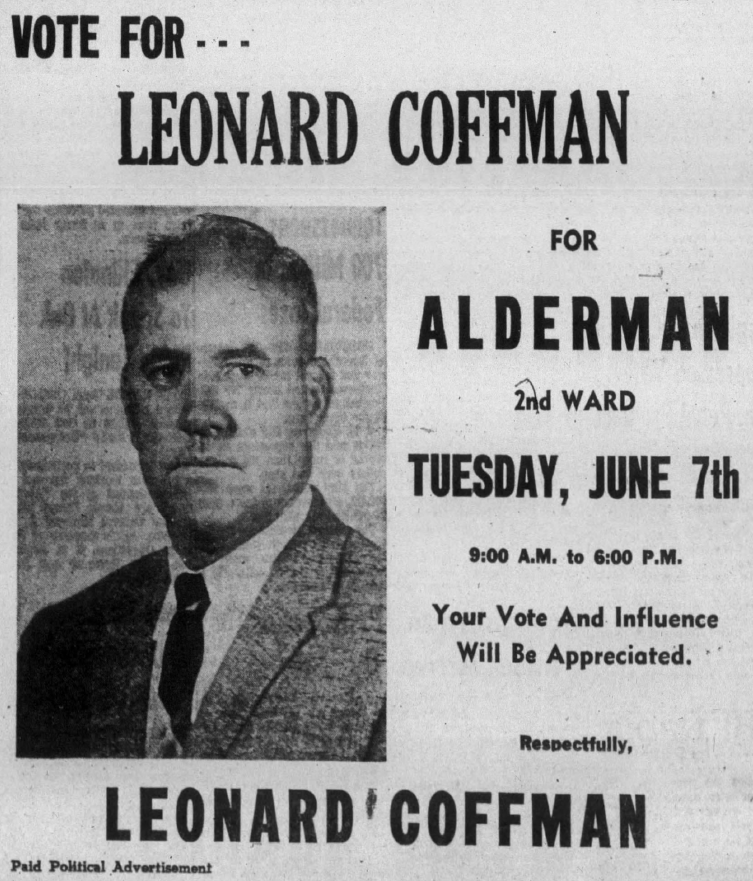
Coffman was also active in veterans’ and civic affairs. He served as senior vice commander of VFW Post 1990 and twice sought election as a Greeneville alderman from the Second Ward, finishing third behind the incumbents in both 1960 and 1962.²⁶
Football officiating became another long chapter of Coffman’s involvement in the sport. He worked games for years after leaving coaching and was honored in 1977 for 15 years of service as an official. That same year, the East Tennessee chapter of the National Football Foundation and Hall of Fame honored Coffman for his contributions to football.²⁷
Later Honors
Coffman’s football career received additional recognition during his later years. He was inducted into the Upper East Tennessee Sports Hall of Fame in 1991 and was selected for the Tennessee Sports Hall of Fame in 1995, with induction following in 1996. The TSSAA Hall of Fame later honored his long career in officiating.²⁸
The honors reflected a football career that extended well beyond a single period or role. Coffman had been an All-Kentucky high school fullback, a Greeneville High player, a Tennessee starter, an Army All-Star, a college assistant, a high school principal and coach, a Greeneville High head coach and a longtime official.
Leonard Amos Coffman died Aug. 30, 2007, in Greeneville at age 92. At the time of his death, he was the last surviving starter from Tennessee’s 1938 and 1939 teams.²⁹
Footnotes
- Daily News (Middlesboro, Ky.), May 17, 1933, p. 2; Sept. 22, 1933, p. 2.
- Daily News, Nov. 6, 1933, p. 2; Jan. 29 and Feb. 13, 1934, p. 2.
- Daily News, Sept. 7 and Nov. 2, 1934, p. 2.
- Daily News, Nov. 8 and Nov. 9, 1934, p. 2.
- Daily News, Nov. 21 and Nov. 27, 1934, p. 2.
- Daily News, Dec. 10 and Dec. 18, 1934, p. 2.
- Greeneville Sun, Sept. 21, 1935; March 12, 1936; Johnson City Chronicle, Sept. 4, 1936; Johnson City Press, May 31, 1964.
- Middlesboro Daily News, date to be verified. The item objected to Knoxville sportswriters referring to Coffman as a Greeneville product and emphasized that he had already been an All-Kentucky fullback at Middlesboro before attending Greeneville High.
- University of Tennessee football records; Associated Press All-Southeastern Conference selections, 1938.
- Knoxville News-Sentinel, Aug. 31, 2007.
- Ibid.
- Knoxville News-Sentinel, Sept. 19, 1983.
- Ibid.; University of Tennessee retrospective on Coffman’s death, Aug. 30, 2007.
- Knoxville News-Sentinel, Sept. 19, 1983; University of Tennessee football records, 1938.
- Knoxville Journal, July 23, 1946.
- Knoxville News-Sentinel, March 15, 1942; Greeneville Sun, April 1, 1942; Atlanta Journal, July 29, 1942.
- Kentucky New Era, Sept. 17, 1942; Three States, Sept. 17, 1942.
- Greeneville Sun, March 8, March 23 and June 24, 1943; Knoxville Journal, March 5, 1946.
- Knoxville Journal, March 5 and July 23, 1946.
- Associated Press, July 23, 1946; Wyoming coaching coverage, March 1947.
- Casper Star-Tribune, July 3, 1951; Wyoming football coverage, 1951–52.
- Casper Star-Tribune, May 19, 1953; Associated Press, May 22, 1953.
- Greeneville Sun, July 9 and Oct. 27, 1953.
- Greeneville Sun, April 18 and April 26, 1955; Johnson City Press, May 31, 1964.
- Greeneville Sun, June 1, 1962; Johnson City Press, May 31, 1964.
- Greeneville Sun, June 1960 and June 1962 election coverage.
- Knoxville News-Sentinel, April 21, 1977.
- Elizabethton Star, May 7, 1991; The Tennessean, Nov. 29, 1995; TSSAA Hall of Fame records.
- Knoxville News-Sentinel, Aug. 31, 2007.