
Grady Leo Adkisson
Greeneville High School Head Football Coach, 1928–1933
Grady Leo Adkisson was Greeneville High School’s first football coach hired specifically to direct the program, beginning a six-season tenure in 1928 that helped establish football as an important part of the school’s athletic program. He compiled a 34–24–4 record through 1933 while also coaching boys’ and girls’ basketball.² ³ His career eventually carried him from the athletic fields of Greeneville to superintendent of Greeneville City Schools, military service during World War II, and nearly three decades of administration at the University of Tennessee.
Adkisson was also part of an unusual connection in Greeneville football history. He was one of three members of Milligan College’s 1924 football team who subsequently became head football coaches at Greeneville High School. His former college teammates T. W. Caskey and Phil Sawyer had preceded him in the position in 1925 and 1927, respectively.¹
Early Life and Milligan College
Adkisson was born March 8, 1905, in Harriman, Tennessee. He attended Harriman High School, where he participated in athletics, including basketball, before continuing his education at Milligan College near Johnson City.¹
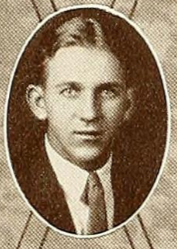
He entered Milligan in 1924 and graduated in 1928. A member of the college’s football team, Adkisson played halfback and was known by the nickname “Blondy.” As a fresman in 1924, he returned a punt for a touchdown against Tusculum.¹
The 1924 Milligan football team included three players who would later direct Greeneville High’s football program. Phil Sawyer, a tackle from Greene County, had played football at Milligan since 1922 and was also a standout baseball pitcher. T. W. Caskey, a senior during the 1924–25 academic year, played halfback alongside Adkisson, then a freshman. Sawyer, Caskey and Adkisson were thus college teammates before their separate coaching careers brought them to Greeneville High School.¹
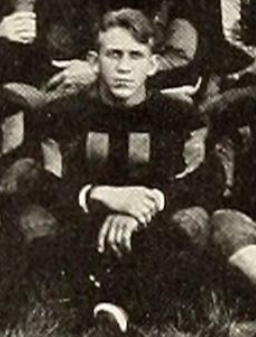
Sawyer and Caskey were already experienced college athletes when Adkisson arrived. Caskey graduated in 1925, while Sawyer, a junior that academic year, had also begun coaching Milligan’s junior varsity football team. Their overlapping careers illustrate the influence Milligan athletics would have on the development of Greeneville High’s early football program.¹
Adkisson also participated in campus activities, including work associated with the student newspaper, The Stampede. He graduated in 1928 with a Bachelor of Arts degree and briefly worked as a field representative for the college, recruiting prospective students.¹
Greeneville High School, 1928–1933
In August 1928, Adkisson was hired to teach at Greeneville High School and become its head football coach. Although the school had fielded football teams under earlier coaches, Adkisson was the first coach employed specifically for that responsibility. He succeeded Phil Sawyer, who had directed the team in 1927, and followed another former Milligan teammate, T. W. Caskey, who had coached Greeneville in 1925.²
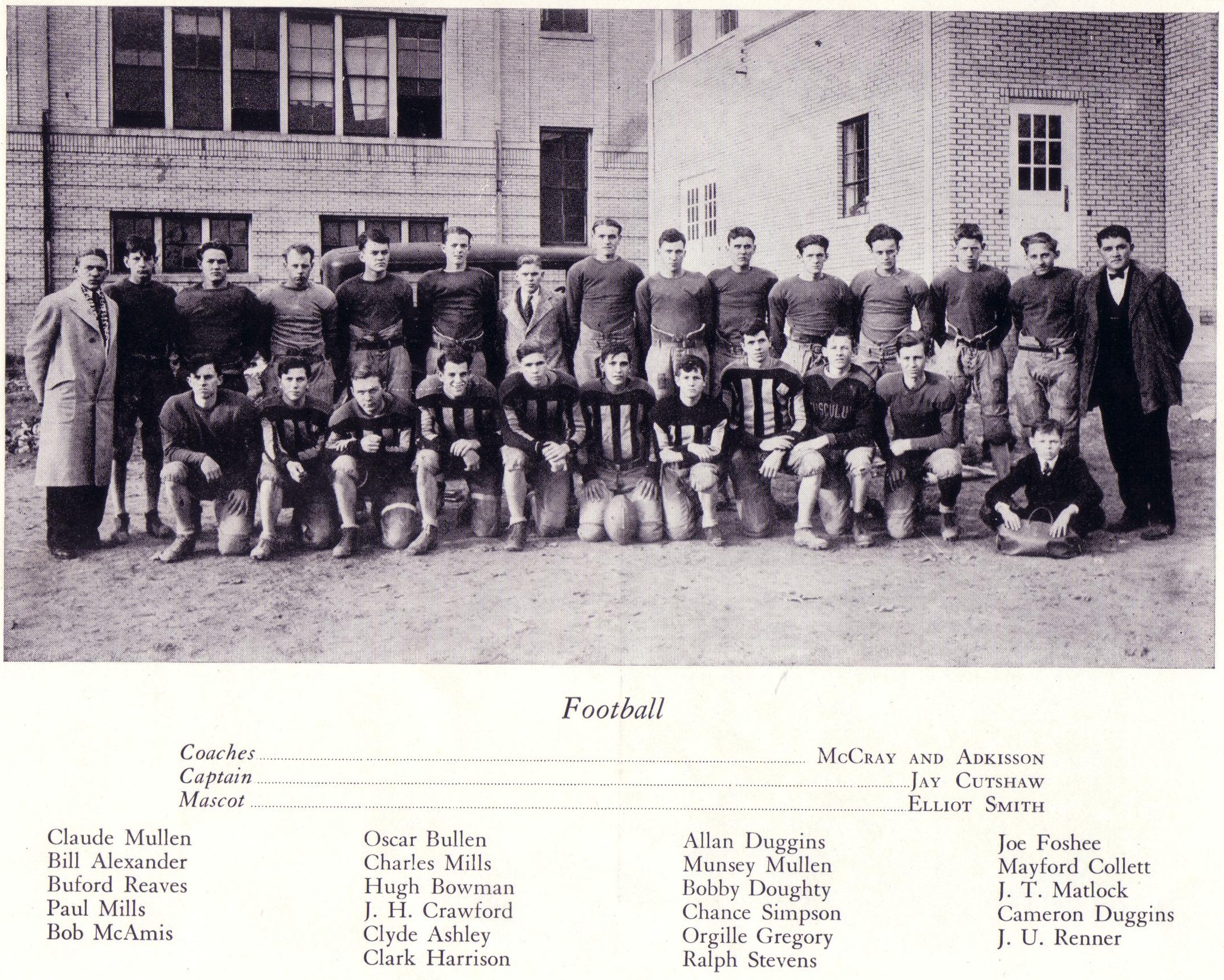
Adkisson taught history and coached both boys’ and girls’ basketball in addition to his football responsibilities. His appointment represented a more organized approach to athletics, with a coach responsible for developing the football program over successive seasons rather than directing it as an additional or temporary assignment.³
His arrival coincided with efforts to improve Greeneville High’s athletic facilities and equipment. He participated in fundraising campaigns supported by local civic organizations, including an effort to construct an athletic building. Athletic fundraising also involved community entertainment and theatrical productions, reflecting the school’s dependence on local support to develop its programs.
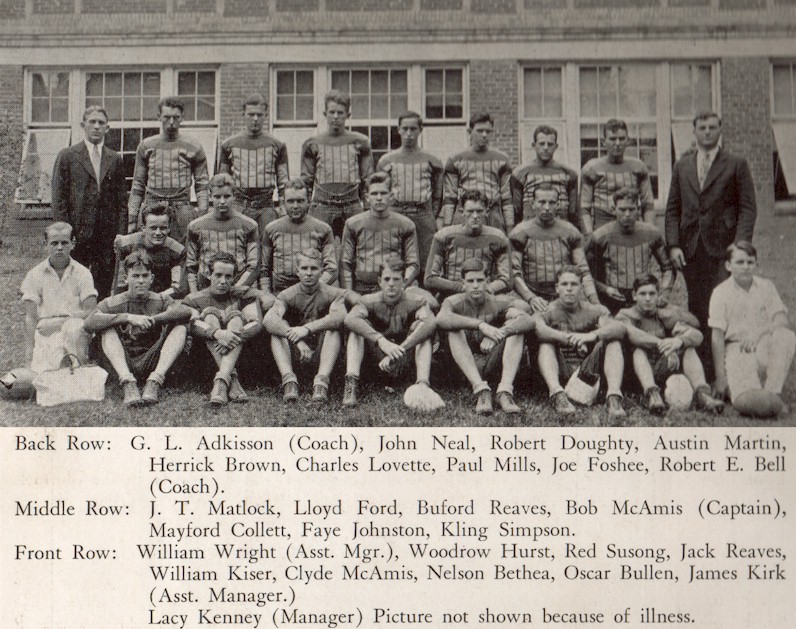
Over six seasons, from 1928 through 1933, Adkisson coached 62 football games, winning 34, losing 24 and tying four, a winning percentage of 54.8%. The winning record established a measure of consistency for a program that had experienced frequent coaching changes during its earlier years.² ³
Adkisson’s six-year tenure also represented an important period of continuity. Rather than changing coaches after one or two seasons, Greeneville maintained the same football leadership while the school’s athletic programs developed. His work in football, basketball and physical education made him an important figure in the expansion of organized school athletics.³
School Administration and Junior High Football
Following his final season as Greeneville High’s head football coach in 1933, Adkisson continued his career in education. In June 1934, the Greene County Board of Education selected him for a teaching position at Mosheim High School. He subsequently returned to Greeneville City Schools in an administrative capacity.⁴
In August 1935, Adkisson was elected principal of Crescent School and assistant supervisor of Greeneville City Schools. His responsibilities increasingly involved school administration, curriculum development and the supervision of classroom instruction.⁴
His interest in athletics continued. When Greeneville established a junior high school football program in 1936, Adkisson became its first head coach, extending organized football to younger students. The program created an additional opportunity for boys to learn the game before entering Greeneville High School and represented another contribution to the development of football in the city school system.⁴
Adkisson also became active in Greeneville’s cultural life. In November 1936, he was elected the first president of the Little Theatre Guild of Greeneville, an organization established to promote community theatrical productions. The guild presented its first production, The Pot Boiler, in February 1937.⁵
By 1937, Adkisson was serving as supervisor of Greeneville City Schools, working on instructional programs and curriculum improvements. His work included efforts to strengthen arithmetic instruction and develop more effective classroom practices. He also participated in teacher training and educational conferences.
Adkisson continued his own education while advancing professionally. In August 1937, he received a Master of Science degree from the University of Tennessee, completing graduate work that included a thesis titled Educational Achievements in the Greeneville Schools. He later pursued doctoral studies at the University of Wisconsin.⁶
His involvement in community organizations continued alongside his school responsibilities. He served as chairman of the Greeneville District of the Boy Scouts during 1939 and 1940 and participated in other civic activities.⁷
Adkisson eventually became superintendent of Greeneville City Schools, the culmination of his progression from classroom teacher and coach to administrator. He held that position in 1942, when World War II interrupted his civilian career.⁸
World War II
In September 1942, Adkisson received a commission as a first lieutenant in the United States Army Air Corps. His departure required Greeneville City Schools to appoint a new superintendent, and Frank Alexander, then principal of Greeneville High School, was selected to succeed him.⁸
Adkisson reported for officer training at Miami Beach, Florida, in October 1942 and subsequently served in Orlando with the Army Air Forces School of Applied Tactics. His assignments included work in the Air Support Department and later service as assistant executive of the Air Forces Special Staff School.⁹ ¹⁰
He was promoted to captain in April 1943 and received a temporary promotion to major in September 1944. He remained in the Army Air Forces until March 1946, completing approximately three and a half years of military service.⁹
Among the people Adkisson met during his wartime assignment was actor Robert Preston, who was also serving in Orlando. Preston a two-time Tony Award-winning actor, was best known for starring in The Music Man. Their friendship continued after the war and later brought Preston to East Tennessee for outdoor recreation with Adkisson.¹⁴
University of Tennessee
After his discharge, Adkisson resumed his educational career at the University of Tennessee. In May 1946, he was appointed associate registrar, beginning a 28-year association with the university.¹⁰
His responsibilities expanded as Tennessee experienced substantial growth in enrollment following World War II. He became assistant dean of admissions and later associate dean of admissions and records, helping administer student registration, academic scheduling, admissions and student services.¹¹ ¹³
By 1950, Adkisson was supervising course scheduling for approximately 7,000 students four times annually and providing academic guidance to large numbers of students. His work required extensive coordination among students, faculty and university departments.¹¹
He also contributed to the development of programs for international students in the years following the war, helping the university respond to the needs of students arriving from other countries.
In November 1969, Adkisson was appointed acting dean of admissions and records. He also served at various times as acting dean of the graduate school, assuming additional administrative responsibilities during periods of transition.¹² ¹³
One of his most lasting contributions involved improving educational opportunities for students with physical disabilities. In 1969, Chancellor Charles Weaver appointed a committee to study the difficulties those students encountered and develop a more systematic means of assistance. Adkisson helped establish the resulting program, which began during the winter quarter of 1970.¹³
Previously, students with disabilities generally had to seek individual assistance from university officials. The new program provided a more organized approach to identifying needs and coordinating services. Adkisson considered the development of this program one of the most important accomplishments of his university career.¹³
Personal Interests and Retirement
Outside his professional responsibilities, Adkisson enjoyed hunting, fishing and outdoor recreation. He was active in the Tennessee Valley Sportsman’s Club and served as its president.¹³
His wartime friendship with Robert Preston remained a notable personal connection. In October 1962, while Preston was in East Tennessee for the filming of All the Way Home, Adkisson arranged a wild boar hunt near Walland. The outing attracted newspaper attention because of Preston’s fame and the men’s longstanding friendship.¹⁴
Adkisson also developed an interest in historical fiction, working on novels set during the pioneer era of the East Tennessee and western North Carolina mountains.¹³
He retired from the University of Tennessee effective August 31, 1974, after 28 years of service. His final position was associate dean of admissions and records, and his career had included periods as acting dean of admissions and records and acting dean of the graduate school.¹³
Adkisson hoped to devote more time to writing and outdoor activities during retirement. His years at Tennessee had taken him from the registrar’s office into senior university administration, where his work had affected thousands of students.¹³
Death and Greeneville High School Hall of Fame
Grady Leo Adkisson died May 5, 1977, in Knoxville at the age of 72. He was survived by his wife, Peggy, his son David E. Adkisson and his daughter Suzanne Darnell.¹⁵
Thirty years after his death, Greeneville High School recognized his contributions to its athletic history. On October 19, 2007, Adkisson was posthumously inducted into the inaugural class of the Greeneville High School Sports Hall of Fame.¹⁶
His son, David, accepted the honor on his father’s behalf and recalled that Adkisson had always spoken fondly of his years in Greeneville. The family expressed its appreciation for the recognition, which acknowledged his role in establishing a more permanent football program at the high school, coaching basketball and introducing football at the junior high level.
Footnotes
- Milligan College, The Buffalo, 1925 and 1927 editions; Johnson City Chronicle, November 1924; The Greeneville Sun, March 22, 1941. The Milligan annuals establish Adkisson’s class standing, his halfback position and his overlap with Sawyer and Caskey.
- The Greeneville Sun, August 29, 1928; Greeneville High School football coaching history, Coaching Records.
- Greeneville High School football coaching history, 1928–1933; 2007 Sports Hall of Fame biographies. The Hall of Fame history records Adkisson’s improving seasons of 3–3 in 1931, 5–2 in 1932 and 4–3 in 1933, as well as his basketball coaching responsibilities.
- The Greeneville Sun, June 1934 and August 1935; Greeneville High School, 2007 Sports Hall of Fame biographies. The latter documents Adkisson’s organization of the junior high football team in fall 1936.
- The Greeneville Sun, November 16, 1936, and February 1937. Organization and first production of the Little Theatre Guild.
- The Greeneville Sun, August 1937; University of Tennessee graduation records, August 27, 1937. Master of Science degree and graduate thesis.
- The Greeneville Sun, March 22, 1941; contemporary Greeneville District Boy Scout reports, 1939–1940.
- The Greeneville Sun, September 17 and 19, 1942. Adkisson’s Army Air Corps commission and Frank Alexander’s appointment as superintendent.
- The Greeneville Sun, April 1943; Johnson City Press, September 26, 1944, p. 2; The Greeneville Sun, March 14, 1946. Military assignments, promotions and discharge.
- The Knoxville Journal, May 4, 1946, p. 5; The Knoxville News-Sentinel, August 10, 1946, p. 7. Appointment as associate registrar and details of wartime service.
- The Greeneville Sun, February 2, 1950, p. 1. University administrative responsibilities and participation in Tusculum College’s Career Week.
- The Knoxville News-Sentinel, November 7, 1969, p. 2. Appointment as acting dean of admissions and records.
- The Knoxville News-Sentinel, September 1, 1974, p. 16. Development of services for students with physical disabilities, university career and retirement.
- The Knoxville Journal, October 16, 1962, pp. 1, 3. Adkisson’s friendship with Robert Preston and their hunting trip.
- The Knoxville News-Sentinel, May 5, 1977, pp. 21, 32. Obituary and surviving family.